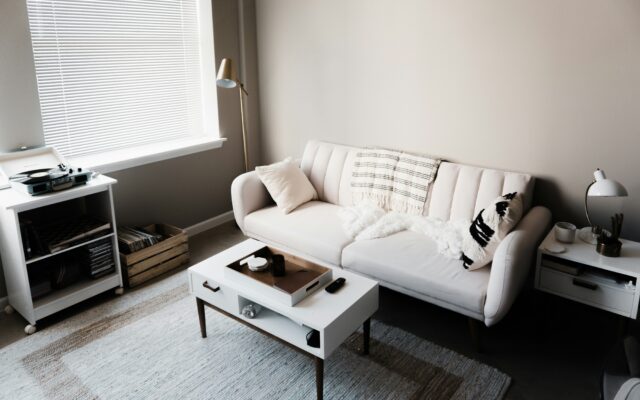
Sharp corners are losing their grip on modern living rooms. Curved furniture has taken over instead, and it’s not just a passing look.
Why Curves Took Over in 2026
Straight-edged, boxy sofas defined the 2010s. Now interiors are softening across the board.
According to Homes & Gardens, designers are seeing a return to stronger, more sculptural forms, but with warmth built in. Sofas are generous and curved. Tables feel weighty. Storage pieces act as anchors instead of afterthoughts.
The shift reflects something bigger than style. Curved shapes echo forms found in nature. That’s part of why a rounded sofa feels more inviting than a rectangular one, even before anyone sits down.
What Counts as Curved Furniture
A curved sofa isn’t limited to one dramatic shape. The curve can be subtle, a softly bowed back on an otherwise normal sofa. Or it can be bold, a full crescent or arc that wraps around a seating area.
This range matters. You don’t need a dramatic, sculptural piece to join the trend. A gently rounded armchair does the job just as well as a full curved sectional.
Why Curves Work So Well in Real Rooms
Curved furniture solves a genuine functional problem, not just a visual one. In a room full of straight edges and hard corners, a curved piece introduces movement the eye can follow.
This matters most in open-concept homes. A crescent sectional can define a clear “conversation zone” without a single wall. That’s real function, not just decoration.
The Materials Leading This Trend
Bouclé remains the most popular fabric choice for curved pieces in 2026. Velvet and performance linen follow close behind, both chosen for how they catch light differently across a rounded surface.
Warm neutrals dominate the color palette. Think oatmeal, ivory, taupe, camel, and mocha. Jewel tones like burgundy and forest green show up too, especially in more luxury-leaning spaces.
How to Start Small With This Trend
Committing to a full curved sofa is a real investment. Start smaller instead, with a round coffee table, a curved mirror, or one rounded side table.
This lets you test whether the look actually suits your space before spending on a larger piece. It also avoids the most common mistake with this trend entirely.
The Balance Formula That Actually Works
Too many curved pieces in one room starts to feel chaotic rather than calm. A simple formula solves this: one warm-toned anchor piece, one curved silhouette, and one textured element.
A curved sofa paired with a rectangular rug and a straight-lined sideboard hits this balance well. The curve stands out precisely because it’s not fighting other curves for attention.
Curves Beyond the Sofa
The sofa usually starts this trend, but it doesn’t have to end there. Rounded dining chairs paired with a circular table bring the same softness to a dining space.
Capsule-shaped coffee tables and arched mirrors extend the look further. Even a single spherical planter can nod to the trend without any furniture commitment at all.
Is This Trend Worth the Investment
Curved furniture tends to cost more than a standard equivalent, since the manufacturing is more complex. But designers increasingly frame this as a long-term piece, not a disposable trend item.
A well-chosen curved sofa in a timeless neutral tone is more likely to outlast a passing style cycle than a boldly patterned straight one. That’s worth factoring in before writing it off as just a 2026 moment.
The Takeaway
Curved furniture works by softening a room’s hard edges while genuinely improving how people move through the space. Start with one piece, balance it against straight lines elsewhere in the room, and choose warm, natural materials that will hold up past this year.
If you’re building a room around one curved anchor piece, getting the furniture arrangement right around it matters just as much as the piece itself.