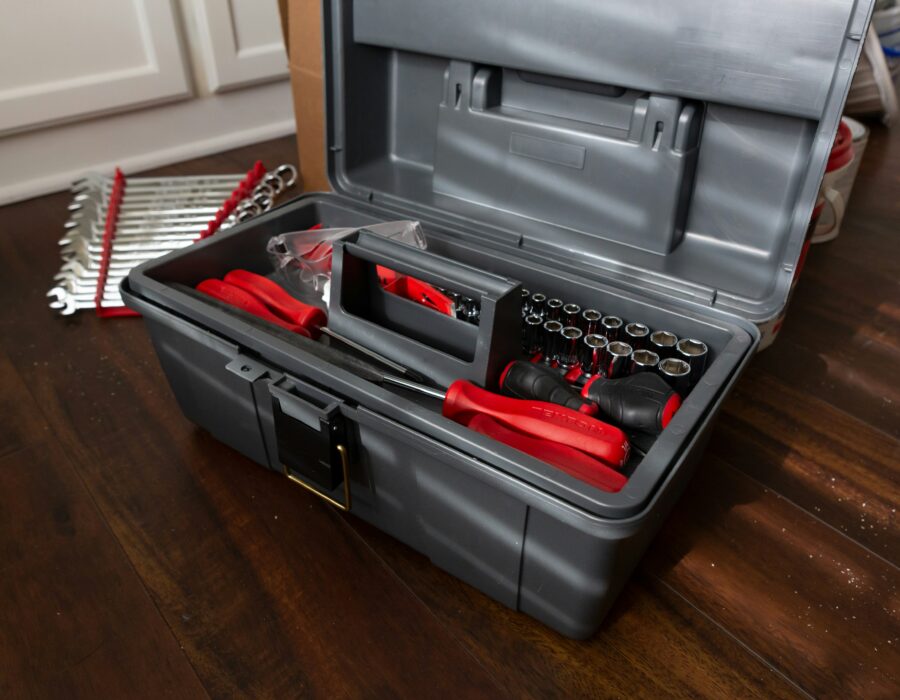
You don’t need a garage full of equipment to handle most home repairs. A focused set of essential tools every homeowner should own covers the vast majority of everyday tasks.
Start With a Good Cordless Drill
A cordless drill is one of the most-used tools in any home. According to Bob Vila, it works for drilling holes, driving screws, assembling furniture, and even mixing paint.
Look for one with adjustable torque settings. This prevents stripping screws in softer materials. A basic 18V or 20V model covers most household needs without overspending on power you won’t use.
A Reliable Tape Measure Is Non-Negotiable
Nearly every project starts with measuring something. A 25-foot retractable tape measure with an auto-lock feature handles almost every household need, from furniture placement to small repairs.
Buy a second one if you can. It’s common to misplace a tape measure mid-project, and having a backup saves a frustrating search.
Keep Both Screwdriver Types on Hand
A basic toolkit needs both flathead and Phillips head screwdrivers. Better yet, get a set with multiple sizes of each, since screws vary more than people expect.
A ratcheting screwdriver with interchangeable bits is worth the upgrade. It combines multiple screwdriver sizes into one comfortable handle, saving space and hassle.
A Claw Hammer Handles More Than Nails
A good hammer drives nails, removes them, and handles light demolition work. Choose one with a comfortable, non-slip grip, since hand fatigue becomes a real issue on longer projects.
A rubber mallet is a useful companion tool. It’s gentler on delicate surfaces and works well for furniture assembly where a metal hammer would leave marks.
A Level Keeps Everything Straight
Hanging shelves, pictures, or cabinets without a level almost guarantees a crooked result. A basic torpedo level works for small tasks, while a longer level suits bigger installations like shelving or furniture.
Digital levels add precise angle readouts for more advanced projects. But a simple bubble level is genuinely enough for most everyday homeowner needs.
A Stud Finder Prevents Costly Mistakes
Mounting anything heavy, shelves, TVs, mirrors, requires knowing where the studs are. A stud finder locates them behind drywall, so your mounting hardware actually has something solid to grip.
Skipping this step is one of the most common reasons a mounted item eventually falls. It’s a small tool that prevents a genuinely frustrating repair later.
Keep a Utility Knife Within Reach
A utility knife handles far more than opening boxes. It’s useful for cutting drywall, trimming materials, and dozens of small tasks that come up during any home project.
Keep extra blades on hand. A dull blade is both less effective and more dangerous than a sharp one, since it requires more force to cut through material.
An Adjustable Wrench Covers Plumbing Basics
A wide-jaw adjustable wrench, ideally 6 to 10 inches, handles most household plumbing fixtures, bolts, and nuts. Look for smooth jaws specifically, since rough jaws can damage fasteners over repeated use.
This single tool often replaces the need for a full wrench set for basic homeowner tasks, though a dedicated set is worth adding later if you take on more plumbing work.
A Good Flashlight or Headlamp Matters More Than You’d Think
Basements, attics, and under-sink repairs all happen in poorly lit spaces. A high-lumen LED flashlight, or better yet, a hands-free headlamp, makes these tasks noticeably easier and safer.
This is one of the most overlooked items on a basic toolkit. But it’s genuinely essential the first time you need to see clearly while both hands are occupied with a repair.
Don’t Forget Basic Safety Gear
Safety glasses, ear protection, and a dust mask matter every time you use a power tool. These items are inexpensive, but skipping them risks real injury over time, especially with repeated sanding, drilling, or sawing.
Store safety gear with your main tools, not separately, so you’re never tempted to skip it because it’s inconvenient to find.
The Takeaway
A focused set of essential tools every homeowner should own, a drill, tape measure, screwdrivers, hammer, level, stud finder, and a few smaller items, covers the overwhelming majority of everyday repairs and projects. You don’t need to buy everything at once. Add tools gradually as specific projects call for them.
Once your basic toolkit is in place, tackling a weekend project like an accent wall becomes far more approachable, since most of what that project needs is already sitting in your toolbox.