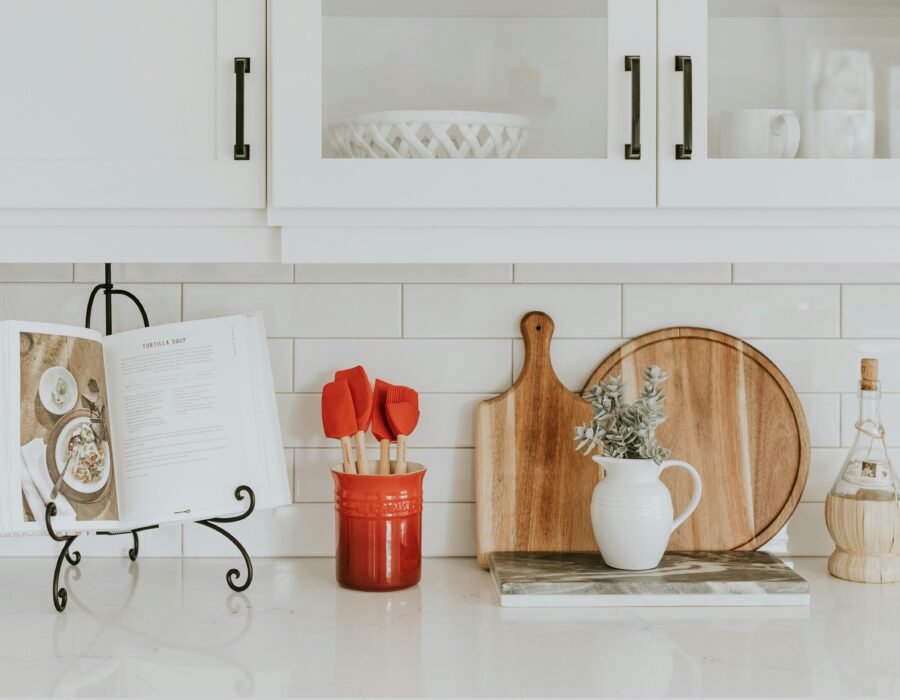
You don’t need a kitchen renovation to fix a cluttered kitchen. Most storage problems come down to how cabinets are used, not how many you have. These kitchen storage hacks work with your existing cabinets, no demolition required.
Start by Working in Zones, Not All at Once
Pulling everything out of every cabinet at once is overwhelming, and it rarely leads to a finished project. Instead, tackle one zone at a time. Pick a single cabinet, empty it, and sort what comes out before putting anything back.
According to The Kitchn, working by zone rather than by room is one of the most consistent tips from professional organizers, since it keeps the task manageable and actually finishable in one sitting.
Assign Each Cabinet a Job
Once you’ve decluttered, give each cabinet a specific purpose. Keep plates, mugs, and glasses near the sink or dishwasher, since that’s where they get put away most often. Store cleaning supplies and extra sponges under the sink, where they’re already close to where you use them.
This single change removes a surprising amount of daily friction. You stop wandering the kitchen looking for the right cabinet, because every cabinet already has a clear job.
Use Vertical Space Inside Each Cabinet
Most cabinets waste the top third of their space simply because stacking plates or pots that high isn’t practical. Adding a stackable shelf riser inside a cabinet effectively doubles its usable space without any installation.
This works especially well for mugs, small bowls, and canned goods, items that are light enough to sit on a riser without stability issues.
Fix the Pot Lid Problem
Almost every kitchen has a stack of pot lids that collapses the moment you try to grab one from the middle. A simple lid rack, either standing or mounted to the inside of a cabinet door, solves this permanently.
It’s a small fix, but it removes one of the most common daily frustrations in a kitchen that otherwise looks fine.
Bring In a Turntable for Deep Corner Cabinets
Corner cabinets are notorious for swallowing items whole. A turntable, sometimes called a lazy Susan, makes everything in a deep cabinet reachable with a simple spin instead of a full-arm reach into the dark.
This works for spices, oils, and condiments just as well as it does for larger items like mixing bowls.
Use the Inside of Cabinet Doors
The inside of a cabinet door is one of the most overlooked storage spots in the entire kitchen. A slim adhesive rack can hold spice jars, small cutting boards, or foil and plastic wrap boxes, all without taking up a single inch of shelf space.
This is especially useful in small kitchens, where every flat surface already has a job and shelf space is limited.
Store Heavy, Occasional-Use Items Low and Back
Standing mixers, slow cookers, and other heavy appliances belong in a lower cabinet, both for safety and ease of use. If an appliance only comes out a few times a year, push it to the back of that cabinet and keep the front space for things you reach for weekly.
This keeps your most-used items at arm’s reach while still making room for the occasional-use pieces you don’t want to get rid of.
Group Items by How Often You Use Them, Not Just What They Are
It’s common to organize by category, all the baking items together, all the spices together, but it helps to add a second layer: frequency of use. Keep your most-used items front and center, at eye level, regardless of category. Push less frequent items higher up or further back.
This means your everyday coffee mug and your once-a-year holiday platter don’t have to compete for the same easy-to-reach shelf.
Use Small Bins for Small, Loose Items
Paper plates, plastic cutlery, and small snack packets tend to end up loose and scattered in a cabinet if they don’t have a designated container. A simple bin keeps these items corralled, so a quick glance tells you what you have without digging.
This is a low-cost fix that makes a noticeably bigger difference than it seems like it should, especially in kitchens shared by a full household.
The Takeaway
You don’t need new cabinets to fix a cluttered kitchen. These kitchen storage hacks, working by zone, assigning each cabinet a job, and using vertical space, work with what you already have.
If your kitchen also opens into a living or dining area, zoning that open-plan space with the same intentional approach makes the whole floor feel more organized, not just the cabinets.